Key Points
- The newly opened Art Zoo museum in Amsterdam reverses traditional zoological displays by confining human visitors inside dark metal cages while taxidermied animals and skeletal displays appear to roam freely.
- Created by Dutch fine-art taxidermists Jaap Sinke and Ferry van Tongeren, the museum draws inspiration from 16th and 17th-century European wunderkammers (cabinets of curiosities).
- All preserved specimens featured in the museum were ethically sourced from European zoos after dying of natural causes, with no animals taken from the wild.
- Located inside a 17th-century canal house that formerly housed Amsterdam’s Biblical Museum, the institution pairs natural history displays with historical architecture and artistic commentary.
- The artists credit 19th-century naturalist Charles Darwin as their third creative collaborator, pitching the venue as a return to natural wonder and scientific curiosity.
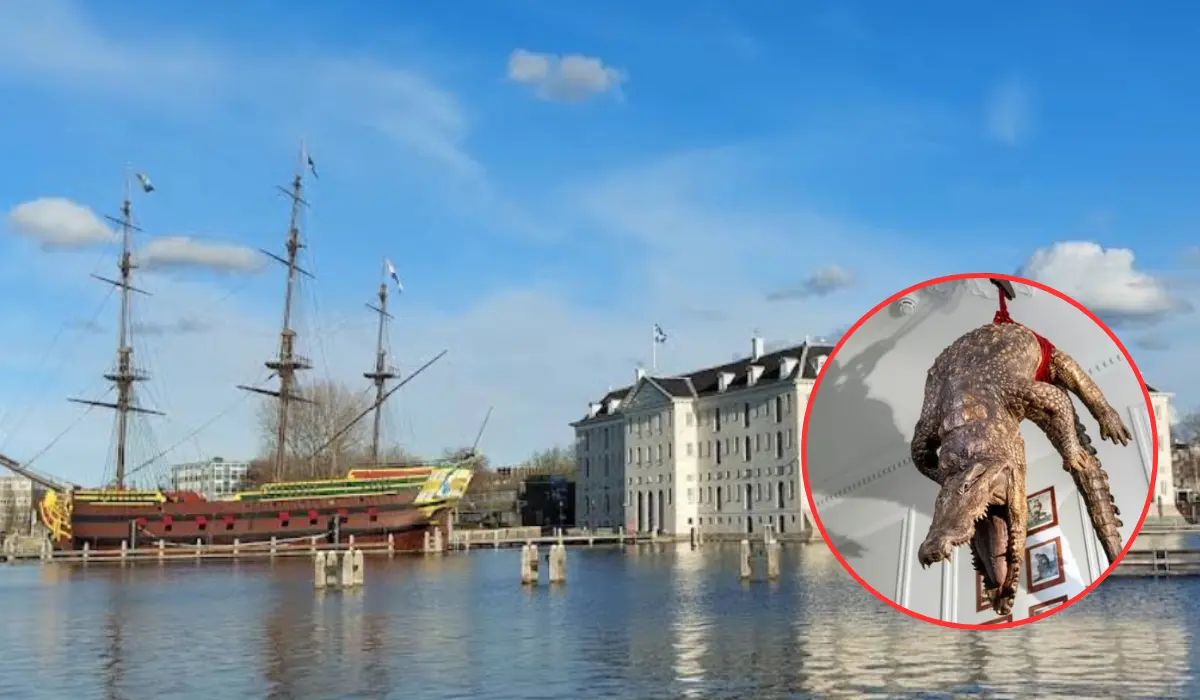
Amsterdam (Amsterdam Time News) October 30, 2026 – Visitors entering Amsterdam’s newly inaugurated Art Zoo museum are greeted by a 12-foot taxidermied crocodile suspended overhead before stepping into brooding, black metal cages that enclose the exhibition galleries. Created by renowned Dutch artists Jaap Sinke and Ferry van Tongeren, the unique cultural institution reverses conventional museum dynamics by placing human spectators behind bars while hundreds of preserved animals, skeletal displays, and macabre art pieces occupy the surrounding open space. The project converts an entire 17th-century canal house into an immersive artwork designed to evoke the dramatic storytelling of golden-age curiosity cabinets.
- Key Points
- What Is the Concept Behind Amsterdam’s Art Zoo Museum?
- Where Do the Animals and Artworks Featured in the Art Zoo Originate?
- Who Are the Artists Behind the Art Zoo Exhibition?
- Background of the Particular Development
- Prediction: How Can This Development Affect the Cultural Tourism Sector and Ethical Taxidermy Art?
What Is the Concept Behind Amsterdam’s Art Zoo Museum?
As reported by Molly Quell of the Associated Press, the Art Zoo offers an unconventional museum experience featuring hundreds of preserved creatures, artfully arranged bone structures, illuminated tulips preserved in apothecary jars, and cabinets filled with grotesque marine specimens.
Rather than replicating natural habitats as traditional natural history museums do, Sinke and van Tongeren inject theatricality and narrative attitude into their displays. Inside the galleries, a cheetah slouches within an alcove under the gaze of a cassowary, while a Japanese giant spider crab extends its 6-foot legs above a doorway alongside mastodon leg bones that reach toward the ceiling.
Describing the central architectural decision to enclose human visitors rather than the animals, co-creator Ferry van Tongeren stated to the Associated Press:
“The main thing is that we like storytelling with the animals. We like to add drama. We add an attitude to the animals, where traditional taxidermists just want to mimic nature. We really like the concept of having all the people in a cage and then all the animals free. In that way, the whole building becomes one artwork.”
Tomáš Vaško, a Slovak resident living in Amsterdam who visited the museum during its opening week, remarked to reporter Molly Quell that the immersive experience felt “a little creepy” as guests walked through the enclosed cage corridors surrounded by staring specimens.
Where Do the Animals and Artworks Featured in the Art Zoo Originate?
As detailed by Residence Magazine and the Associated Press, the artistic duo—who formally work under the collective name Darwin, Sinke & Van Tongeren—adhere to strict ethical standards regarding specimen collection. None of the animals on display were killed or harvested from the wild.
In an interview with the Associated Press, Jaap Sinke clarified the procurement process:
“All our animals come from zoos where they died of natural causes. Still, the paperwork can be challenging. We primarily obtain specimens from Europe to ensure we know the history of the animals.”
In addition to real taxidermy, the museum displays historical oddities and synthetic creations. Positioned beneath the suspended crocodile is a wall exhibiting “Jenny Hanivers”—carcasses of skates and rays modified into grotesque, dragon-like figures by 16th-century sailors to sell to gullible European collectors as legendary sea monsters.
The artists also incorporate a wall display featuring busts of naturalist Charles Darwin turned sideways. Sinke and van Tongeren view Darwin as a primary intellectual contributor to their work and noted the irony of honoring the father of evolutionary theory inside a building that historically housed Amsterdam’s Biblical Museum.
Who Are the Artists Behind the Art Zoo Exhibition?
As reported by UNB News and Residence Magazine, Jaap Sinke and Ferry van Tongeren previously worked in the advertising industry before transitioning full-time into fine-art taxidermy.
The pair achieved global prominence in the art world in 2015 when British contemporary artist Damien Hirst purchased their entire debut exhibition—comprising 38 custom taxidermy compositions—during a gallery show in London. The commercial success enabled the duo to expand their practice, leading to the creation of permanent exhibition spaces and temporary installations across Europe.
According to Sinke and van Tongeren, their goal with the Art Zoo is to revive the spirit of 16th and 17th-century European wunderkammers, where wealthy collectors gathered rare natural specimens to cultivate awe, confusion, and scientific curiosity among guests.
Background of the Particular Development
The establishment of the Art Zoo museum in Amsterdam highlights a broader contemporary movement bridging natural history, fine art, and immersive theater. Historically, taxidermy developed as a scientific tool for biological documentation and hunting trophy preservation during the 19th century. However, modern fine-art taxidermists have increasingly used ethically sourced animal remains to explore themes of mortality, human-nature dynamics, and historical collecting habits.
The location chosen for the Art Zoo—a historic grachtenpand (canal house) along Amsterdam’s heritage belt—shares space with the Vrije Academie. The building previously accommodated the Biblical Museum (Bijbels Museum), which showcased artifacts, models, and Judeo-Christian religious history for decades before shifting its operational model to traveling exhibitions. Converting the classical building into a cage-lined cabinet of curiosities highlights how historic urban real estate in European capitals is being repurposed for specialized cultural tourism.
Prediction: How Can This Development Affect the Cultural Tourism Sector and Ethical Taxidermy Art?
The launching of the Art Zoo museum in Amsterdam is anticipated to generate distinct impacts across the museum sector, tourism markets, and contemporary art practices:
- For Amsterdam’s Cultural Tourism Market: The museum offers a niche, year-round attraction appealing to visitors seeking alternative, dark-heritage, or immersive art experiences outside mainstream institutions like the Rijksmuseum or Van Gogh Museum. Its launch during the autumn season aligns with growing tourist demand for atmospheric and unconventional cultural venues.
- For Contemporary Fine-Art Taxidermists: Sinke and van Tongeren’s high-profile museum model demonstrates a viable commercial and exhibition framework for fine-art taxidermy. By transparently sourcing specimens exclusively from European zoological gardens that die of natural causes, the artists set an operational standard for ethical compliance and regulatory paperwork within the international art market.
- For Traditional Natural History Exhibitions: The popularity of interactive role-reversal concepts—such as placing spectators inside cages—may influence how traditional natural history museums design future public galleries, encouraging more experiential and narrative-driven spatial layouts.