Key Points
- Massive Turnout in Amsterdam: An estimated 200,000 people filled the streets of Amsterdam to participate in the fourth major “Red Line” demonstration, demanding immediate policy changes and sanctions regarding the Dutch government’s approach to Israel.
- Coalition of Human Rights Groups: The mass rally was co-organised by a broad coalition of 13 major civil society and non-governmental organisations, including Oxfam Novib, Pax, Amnesty International Netherlands, and Save the Children.
- Pro-Hamas Sign Controversy: Dutch public broadcaster NOS reported that individuals on the sidelines of the march displayed a sign reading “We Support Hamas”. Organisers and participants firmly distanced the event from the statement, shouting that they would never support Hamas.
- Organiser Statement: Rolien Sasse, director of peace organisation Pax, acknowledged ahead of the march that pro-Hamas activists might attempt to join, stating that while complete control is impossible, organisers explicitly rejected pro-Hamas sentiments.
- Escalating Movement: The demonstration marks the fourth “Red Line” event since May 2025, following a massive protest in October 2025 that drew an estimated 250,000 attendees.
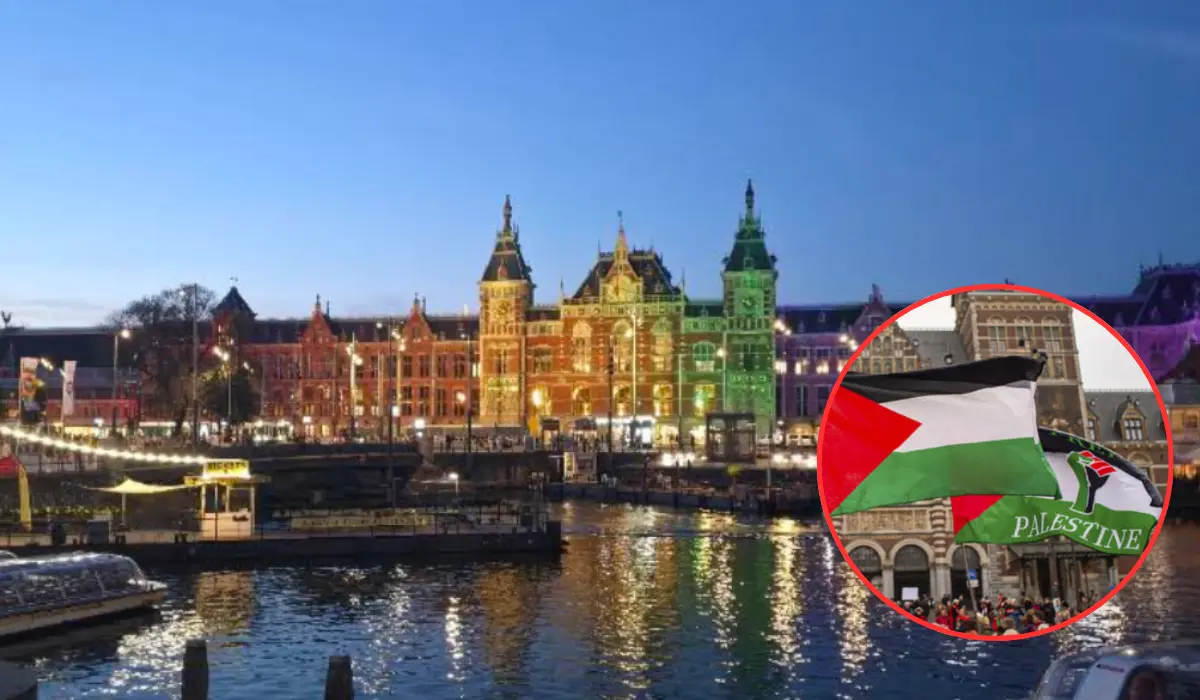
Netherlands (Amsterdam Times News) November 10, 2026 – Around 200,000 people gathered in Amsterdam on Sunday to protest the Dutch government’s policy toward Israel, according to local media reports, marking the latest edition in a series of “red line” demonstrations in which participants dress in red to form a visual line against alleged war crimes against Palestinians
- Key Points
- What Triggered the Controversy Surrounding the “We Support Hamas” Banner?
- How Has the “Red Line” Movement Grown Since Its Inception?
- What Are Demonstrators Demanding From the Dutch Government?
- Background of the Particular Development
- Prediction: How This Development Can Affect the Dutch Political Landscape, Foreign Policy, and Civil Society
An estimated 200,000 demonstrators clad in symbolic red attire assembled in central Amsterdam on Sunday to demand that the Dutch government enforce strict sanctions and cease political support for Israel. Organised by a coalition of 13 major non-governmental organisations—including Pax, Oxfam Novib, and Amnesty International Netherlands—the rally represented the fourth large-scale “Red Line” mobilization in the country. However, public focus was partially drawn to peripheral controversies after reporters observed a sign explicitly expressing support for Hamas. Demonstration organisers and march participants swiftly condemned the sign, reiterating that the movement is rooted in international law and human rights rather than backing militant factions.
What Triggered the Controversy Surrounding the “We Support Hamas” Banner?
As reported by Dutch public broadcaster NOS (Nederlandse Omroep Stichting), some individuals on the sidelines of the major demonstration held a sign explicitly stating “We Support Hamas”. NOS reporters on the ground noted that this sentiment was not shared by the organisers or the broader crowd, observing that surrounding participants actively shouted that they would never support Hamas.
As reported by Amsterdam local broadcaster AT5, Rolien Sasse, director of the peace organisation Pax—one of the primary institutions behind the mass gathering—addressed the potential presence of peripheral extremist groups prior to the march starting. AT5 highlighted that a previous pro-Palestinian gathering in Amsterdam on October 7, 2023, had similarly featured pro-Hamas banners and slogans.
Speaking to AT5 ahead of Sunday’s assembly, Rolien Sasse stated: “I don’t know, and we never have that completely under control,” acknowledging the logistical reality of managing public crowd margins. Explicitly distancing the broader “red line” initiative from pro-Hamas sentiment, Rolien Sasse stated: “but we absolutely do not want that. But I think there are many, many more people who are in favor of human rights in a very respectful way, and that is what this demonstration is about”.
How Has the “Red Line” Movement Grown Since Its Inception?
As reported by the Dutch English-language news outlet NL Times, Sunday’s assembly represented the fourth major “Red Line” demonstration held in the country. The movement originally launched in May 2025 under the guidance of the Dutch NGO Oxfam Novib, with its inaugural gathering attracting approximately 100,000 participants who formed human chains to symbolize a legal and moral “red line” against military actions.
As detailed by NL Times, the movement has expanded significantly over the past 18 months, drawing support from a coalition of 13 leading human rights and humanitarian organisations, including Amnesty International Netherlands, Pax, and Save the Children. According to figures published by NL Times, the previous edition of the protest—held in October 2025—drew an estimated 250,000 demonstrators, making it one of the largest mass public gatherings in recent Dutch history.
During Sunday’s demonstration, marchers assembled at the central Museumplein before moving in a wide loop around Vondelpark and returning to the main stage. Demonstrators carried Palestinian flags, wore red clothing, and held placards calling for arms embargoes, trade restrictions, and an immediate halt to foreign policy alignments that activists argue enable ongoing human rights violations in Gaza and the West Bank.
What Are Demonstrators Demanding From the Dutch Government?
As reported by NOS, participants in the Amsterdam rally expressed profound frustration with the pace and substance of official diplomatic efforts undertaken by the Dutch government. Demonstrators reiterated calls for formal trade sanctions, the suspension of bilateral technology transfers, and stronger measures in international forums.
As reported by NOS journalist teams speaking directly to participants along the route on Sunday, one demonstrator stated: “I still believe that the Netherlands is not doing enough. This is already the third time I have taken part in this march”. Explaining her persistent attendance despite political inertia, the participant stated: “It probably makes very little difference, but it is the only thing you can do”.
Background of the Particular Development
The “Red Line” movement emerged in early 2025 as a direct response to escalating casualties and humanitarian crises in the Palestinian territories. Spearheaded by Dutch civil society groups, the red clothing symbolises a boundary under international law—specifically the Geneva Conventions and rulings from the International Court of Justice (ICJ) in The Hague—that campaigners argue European nations must enforce against military operations affecting civilian populations.
Since the inaugural demonstration in May 2025, the Dutch political landscape has faced severe strain. Parliamentary debates in The Hague have frequently divided coalitions over military export licensing, diplomatic posture at the United Nations, and EU-level trade agreements with Israel. While the Dutch government has consistently emphasized diplomatic channels and humanitarian aid funding, human rights organisations contend that current foreign policy falls short of binding international legal obligations.
Concurrently, public assemblies in the Netherlands have faced intense scrutiny surrounding freedom of speech, public safety, and anti-Semitism. Municipal authorities in Amsterdam have repeatedly balanced the constitutional right to protest against concerns over fringe extremist messaging, leading to heightened security protocol during multi-thousand-person rallies.
Prediction: How This Development Can Affect the Dutch Political Landscape, Foreign Policy, and Civil Society
The persistent scale of the “Red Line” demonstrations—consistently gathering hundreds of thousands of citizens—will have distinct long-term impacts on key political and social sectors in the Netherlands.
Impact on the Dutch Government and Parliamentary Policy
For Prime Minister Rob Jetten’s administration and parliamentary lawmakers in The Hague, recurring demonstrations of 200,000 or more citizens represent a sustained domestic political pressure point. As public rallies draw backing from mainstream NGOs rather than purely radical fringes, moderate MPs may face mounting voter pressure to support formal reviews of bilateral trade agreements, conditional arms export controls, or expanded humanitarian aid commitments within the European Union.
Impact on Civil Society Organisations and Coalition Strategy
For human rights NGOs such as Pax, Oxfam Novib, and Amnesty International, maintaining clear boundaries between peaceful advocacy for international law and unapproved fringe elements (such as pro-Hamas agitation) remains a critical challenge. In response to sideline incidents, coalition leaders are likely to introduce stricter internal messaging protocols and active volunteer marshaling along protest routes to prevent extremist messaging from overshadowing their core demands for human rights enforcement.
Impact on Public Polarization and Municipal Security
For Dutch citizens and municipal authorities in major cities like Amsterdam, public demonstrations of this magnitude will dictate future public space management and security strategies. Continued high-volume actions may intensify political debate between opposing domestic voter bases over foreign policy, while city officials will be required to dedicate substantial law enforcement resources to preserve public order during large-scale urban marches.